Cyrus Pitt Grosvenor
Founder of New York Central College — minister, abolitionist, architect of an idea.
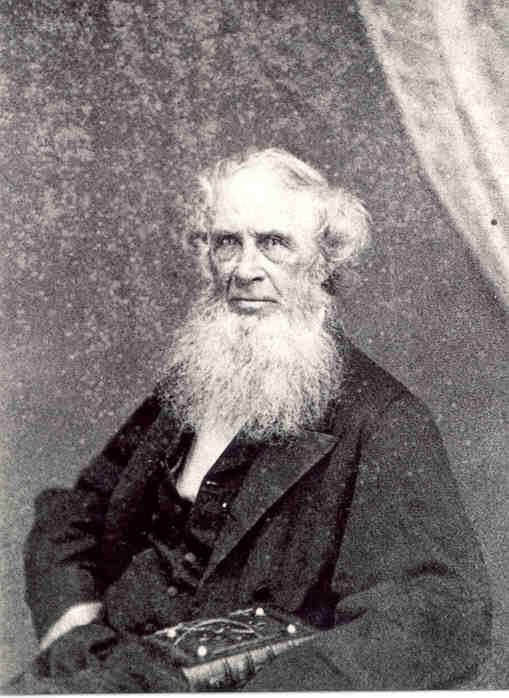
Cyrus Pitt Grosvenor was not, in the conventional sense, a man of the academy. He was a country minister, a pamphleteer, an organizer of breakaway societies and dissenting conventions. Yet by the autumn of 1849, when the doors of New York Central College opened in McGrawville, no single figure had done more to bring that improbable institution into being — and none would more fully embody the convictions on which it was founded.
A Minister of Principle
Born in Grafton, Massachusetts in 1792, Grosvenor was raised in the austere world of the New England parsonage and educated at Dartmouth and the Princeton Theological Seminary. Ordained a Baptist minister, he served congregations across Massachusetts and Connecticut for nearly two decades. From the pulpit, and increasingly from the press, he grew into one of the foremost antislavery voices in his denomination.
He held that no church could remain in fellowship with those who bought and sold human beings. When the great Baptist missionary societies of the day proved unwilling to refuse the contributions of slaveholders, Grosvenor refused them in turn. In 1843 he helped found the American Baptist Free Mission Society — a body that would accept no money built on bondage and would send no missionary who would not preach against it. He served as its first president, and edited the antislavery paper that became its voice.
His was a stance forged at real cost. To break with one's denomination in nineteenth-century America was to break with one's livelihood, one's friends, and a large part of one's world. Grosvenor broke anyway.
“We can have no fellowship with the unfruitful works of bondage; the cup of the Lord and the cup of the slaveholder we cannot drink together.”
Building a Different College
The same network of Free Mission Baptists, Liberty Party reformers, and abolitionist philanthropists that had built the Free Mission Society soon turned its attention to a more ambitious project: a college that would refuse, from its founding day, the racial and sexual exclusions that governed every other American institution of higher learning. The site they chose was a quiet crossroads in Cortland County, New York — the village of McGrawville.
Grosvenor was among the principal founders, and in 1849 he was named the first president of New York Central College. Under his charge the institution made plain what other colleges would not say aloud for another century:
- · that admission would be open to students of every race, on terms of full equality;
- · that women would be admitted to the same curriculum, the same classrooms, and the same degrees as men;
- · that Black scholars — among them Charles L. Reason and, soon after, William G. Allen — would be appointed to the faculty and would teach white students as a matter of course.
No college in America had attempted all three at once. Oberlin had admitted Black students; a handful of academies had admitted women. New York Central College did both, and then went further, by placing African American professors at the head of its classrooms. That last decision, more than any other, marked the institution as something new in the world. Grosvenor defended it without apology.
“Without distinction of color, sex, or condition.”
A Vision Ahead of Its Time
What was scandalous in 1849 has, by slow degrees, become the ordinary furniture of American higher education. Coeducation, the admission of students of every race, the presence of Black faculty in front of white students — each of these is now so unremarkable that we forget there was ever a moment when a college had to be founded to defend them.
New York Central College survived only eleven years. It was driven under by debt, by the relentless hostility of its neighbors, and by the violence loosed upon its community in the wake of the Allen–King affair. Yet what it attempted in McGrawville did not disappear with it. The institutions of the Reconstruction era, the historically Black colleges, the women's colleges, the integrated faculties of the twentieth century — all walked, knowingly or not, in the footprints first laid down by Grosvenor and his colleagues.
Beyond the College
Grosvenor stepped down from the presidency in 1851, but he remained a trustee, a fundraiser, and a stubborn defender of the college's reputation in the antislavery press. After the death of his daughter in 1853, and his wife Sarah in 1856, he withdrew with his surviving family to Albion, Michigan. During the Civil War — with a price said to have been placed upon his head in the South — he travelled for a time in England.
His later years bent toward a quieter set of pursuits. He took up mathematics, returning to the ancient problem of squaring the circle, and published in 1868 a small pamphlet describing his method; his approximation of π erred only in the fourth decimal place. The following year he received an honorary Doctor of Laws. He also filed a patent — for an improvement to lamps, meant to prevent the household explosions that had killed so many in his century. In each of these ventures one sees the same mind: practical, moral, restless, unwilling to accept that any inherited problem must remain unsolved.
He died in Albion in February 1879, in his eighty-seventh year, and was buried at Riverside Cemetery. The college he founded had by then been shuttered for nearly two decades, its buildings sold, its records scattered. The idea, however, outlived him — and outlives him still.
“The work of education is the work of freedom; where the one is withheld, the other cannot stand.”