The Campus at McGrawville
“A Quiet and Pleasant Place”
New York Central College stood near the village of McGrawville in Cortland County, New York, in what one college catalogue described as “a quiet and pleasant place, at a little distance from the village.”
The setting was modest, rural, and practical. But on this hill, one of the most radical educational experiments in the United States took physical form: an interracial, coeducational college where Black and white students, women and men, studied together before the Civil War.
The cornerstone of the main college building was laid on July 4, 1848. Classes opened the following year under the leadership of Rev. Cyrus Pitt Grosvenor.
Campus at a Glance
The Main College Building
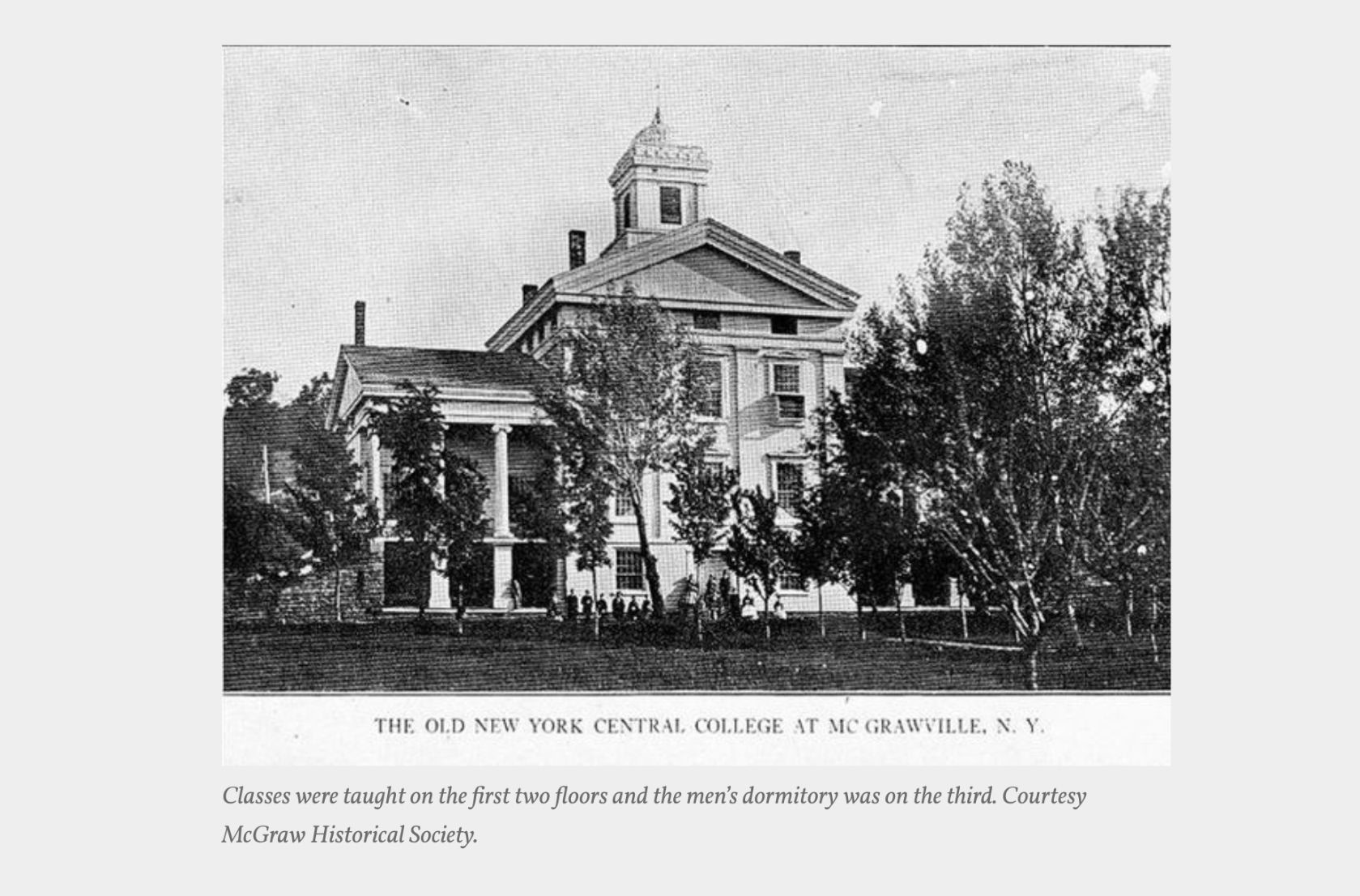
The principal building was a Greek Revival structure that served as the center of campus life.
Classes were taught on the first and second floors. The men’s dormitory occupied the third floor. Within this one building, students attended recitations, listened to lectures, gathered for exercises, and lived out the daily reality of the college’s founding principle.
The building was not a monument to wealth. It was built for use: classrooms, dormitory space, public exercises, and the work of a young institution trying to prove that education could belong to all qualified students, regardless of race or sex.
The Women’s Boarding Hall
Women studied alongside men at New York Central College, but they did not live in the same dormitory.
Sources describe a separate women’s boarding hall near the main building. This arrangement reflected the gender expectations of the nineteenth century, even within a college that challenged those expectations by allowing women to pursue serious academic study.
The women’s boarding hall is an important reminder that New York Central College was both radical and still shaped by the world around it. It opened doors that most institutions kept closed, but it did so within the social limits and practical arrangements of its time.
The College Farm
The campus included a working farm of about 167 acres.
The college farm was more than a source of income. It reflected the founders’ belief that intellectual education and practical labor belonged together. Students studied Greek, Latin, mathematics, philosophy, and science while also helping sustain the institution through productive work.
Manual labor was not an afterthought. It was part of the college’s educational philosophy and financial structure. Students could reduce their expenses by working on the farm or in boarding arrangements, making education more accessible to those who could not afford elite college life.
The farm also gave the college a democratic character. Study and labor belonged together. Students who read Greek, Latin, mathematics, and moral philosophy also worked the land that helped sustain the school.
Daily Life
Life at New York Central College combined study, work, worship, debate, and discipline.
Students attended classes and recitations, participated in chapel or religious exercises, worked on the farm, boarded in college-related housing, and took part in the intellectual culture of the school.
The literary societies were especially important. The catalogue documents two student societies — the Union and the Dialexian — which met weekly and were open to the public. These societies gave students experience in public speaking, debate, composition, and civic argument.
That detail matters. New York Central College was not simply training students to pass examinations. It was training them to speak, argue, organize, and enter public life.
The Village and the Railroad
McGrawville was not a large city or established college town. It was a small village that saw both moral and practical promise in the new institution.
Local residents helped raise funds and secure the college’s location. The village was near Cortland and connected to wider movement through the Syracuse and Binghamton Railroad. That connection mattered. Students, speakers, newspapers, reformers, and visitors could move between McGrawville and the broader abolitionist world.
The college was rural, but it was not isolated.
Disease and the Cemetery
The physical history of New York Central College also includes illness and death.
Smallpox struck the college community during its short life. Students died, and the cemetery connected to the college remains one of the most solemn surviving reminders of what happened there.
The cemetery gives the campus story a human weight. It marks not only an institution, but young people who came to McGrawville seeking education, opportunity, and freedom — and never left.
After the College
New York Central College ceased collegiate instruction around 1859–1860 after years of financial crisis, public hostility, institutional instability, and disease.
The property did not vanish immediately. In 1864, Gerrit Smith sold the site to the New York Central Academy. The buildings continued to serve educational purposes before later changes transformed the school grounds.
The college itself was gone, but the site remained tied to education in McGrawville.
What Remains
The original buildings no longer stand. What remains are photographs, engravings, newspaper clippings, catalogues, local memory, the cemetery, and the historical marker.
Together, those fragments allow the campus to be reconstructed — not perfectly, but meaningfully.
Today little remains of the original campus beyond its cemetery, historical marker, photographs, and scattered records. Yet the ground where the college stood remains one of the most significant sites in the history of American higher education. Here, decades before the Civil War, equality was not merely debated—it was practiced.