Angeline Stickney
Mathematician, Educator, Suffragist
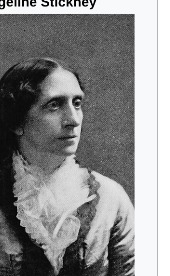
A member of New York Central College's first graduating class, Angeline Stickney became one of the most accomplished women associated with the institution. A gifted mathematician and teacher, she later performed many of the calculations that contributed to the discovery of the moons of Mars.
A Student of Radical Equality
Born in 1830 to a farming family in upstate New York, Chloe Angeline Stickney came of age in a world that offered women few seats in the lecture hall and fewer still at the laboratory bench. In 1847 a small legacy from a cousin opened the door to three terms at the Rodman Union Seminary; soon afterward, with the assistance of her sister Ruth, she made her way to the village of McGrawville and to the recently opened New York Central College.
At McGrawville she pursued the full collegiate course — calculus, mathematical astronomy, the natural sciences, the ancient and modern languages — alongside Black and white men and women in the same classrooms. She helped pay her way by teaching the younger students. In 1855 she graduated with the college's first regular class.
It was in the lecture rooms and dormitories of New York Central College that Stickney was first drawn to the causes that would animate the rest of her life: the abolition of slavery and the political enfranchisement of women.
New York Central College was among the few institutions in America where women could pursue serious collegiate study alongside men — and where intellectual achievement was valued regardless of sex or race.
Teacher and Scholar
Stickney remained at the college after graduation as a tutor, teaching geometry and German. Her command of mathematics was such that her classmates made a sport of devising problems they thought would defeat her. By the testimony of those who knew her, she never failed to solve one.
Among her students was a serious young man from Goshen, Connecticut, two years her junior in years and several behind her in formal training — Asaph Hall. He had come to McGrawville with little money and less Latin, drawn by the college's willingness to take him as he was. Under Stickney's tutelage he learned the mathematics that would define his career; he also fell in love with his teacher.
The Discovery of the Moons of Mars
Stickney and Hall were married in 1856. As was the custom of the century, she set aside her own formal scientific career upon marriage, but not the work itself. When Hall struggled to find steady employment, it was Stickney who wrote to Captain Gillis of the United States Naval Observatory in Washington and pressed her husband's case; the appointment that followed launched his professional life.
Through the long years at the Observatory she carried on as his quiet collaborator — performing the painstaking calculations on which any nineteenth-century astronomical observation depended. Pencil work in those days was no small thing: every position, every orbit, every reduction of raw observation to scientific result passed through hours of manual computation.
In the summer of 1877, with Mars at an unusually close approach to Earth, Hall began a deliberate search for satellites that no one had ever seen. After several discouraging nights he was ready to abandon the effort. It was Stickney who urged him to continue. On the nights of August 17 and 18, peering through the Observatory's twenty-six-inch refractor, he found them: two faint companions circling the red planet. They were given the names Phobos and Deimos.
Without Angeline Stickney Hall, the discovery of Mars's moons might never have occurred.
Years later, the largest crater on Phobos would be named Stickney in her honor — a small recompense from a century that had been unwilling, when she asked, to pay her a man's wage for a man's work.
Legacy
Through all of it Stickney remained what McGrawville had made her: a suffragist, an abolitionist, a believer that the life of the mind belonged equally to women and to men. She raised four sons, every one of whom went on to Harvard; she home-schooled them herself in the early years. She died in 1892 at the age of sixty-one.
Her story is in many ways the story of the college that formed her. She found at McGrawville something that nineteenth-century America otherwise refused to offer her — and she carried what she had been given out into the wider world, into a federal observatory and onto the surface of another planet.
Angeline Stickney demonstrated what New York Central College's founders believed from the beginning: that talent and intellect were not limited by race, sex, or social position.